

Comfort depends on more than a warm seat. The most useful smart bidet toilet features bring together adjustable cleansing settings, heated seating, and automatic functions, with amenities such as warm-air drying, deodorizers, and nightlights available on some models. These options can make daily bathroom routines feel more comfortable and convenient.
It’s reasonable to start with headline features, but the details shape how a toilet feels in everyday use. Water temperature and pressure controls let you tailor cleansing, while automatic opening, closing, or flushing can reduce manual steps. Since models differ, separate the features you’ll use daily from extras you may rarely need.
This guide explains how cleansing settings work, what heated seats and automatic functions add, and how to weigh amenities against your preferences. You’ll also learn how to choose between a smart bidet seat and a complete smart toilet, focusing on comfort, hygiene, and practical fit rather than a long feature list.
Key Takeaways
- Compare water temperature, pressure, and spray adjustments to find cleansing settings that feel comfortable for you.
- Consider whether automatic flushing, a moving lid, or hands-free controls would make your daily routine simpler.
- Choose a heated-seat option based on the comfort you want and how you expect to use the toilet.
- Weigh practical amenities such as warm-air drying, deodorizers, and nightlights against features you’re more likely to use.
- Decide whether a bidet seat, bidet toilet, or bidet toilet combination best suits your bathroom plans and preferred level of integration.
Bidet cleansing and adjustable water temperature
A well-designed wash lets you adjust water temperature, spray position, and pressure to suit your preferences. These controls matter because cleansing should feel comfortable and manageable, not like a preset routine you have to tolerate. Try gentle pressure and moderate warmth first, then adjust one setting at a time. This makes it easier to find what feels right.
Look for separate temperature and pressure controls, along with an adjustable spray position. A range of settings can help household members personalize a shared bathroom. If the control panel or remote offers user presets, you can save preferred settings instead of readjusting each time. Prioritize controls that are clear and easy to reach.
Spray design also affects the experience. An adjustable nozzle can direct the stream where it is needed, while different wash modes may offer a broader or more focused spray. Read the product instructions to understand each mode and its purpose. If you are comparing integrated options, this TOTO G5A bidet toilet page provides one example to consider alongside other configurations.
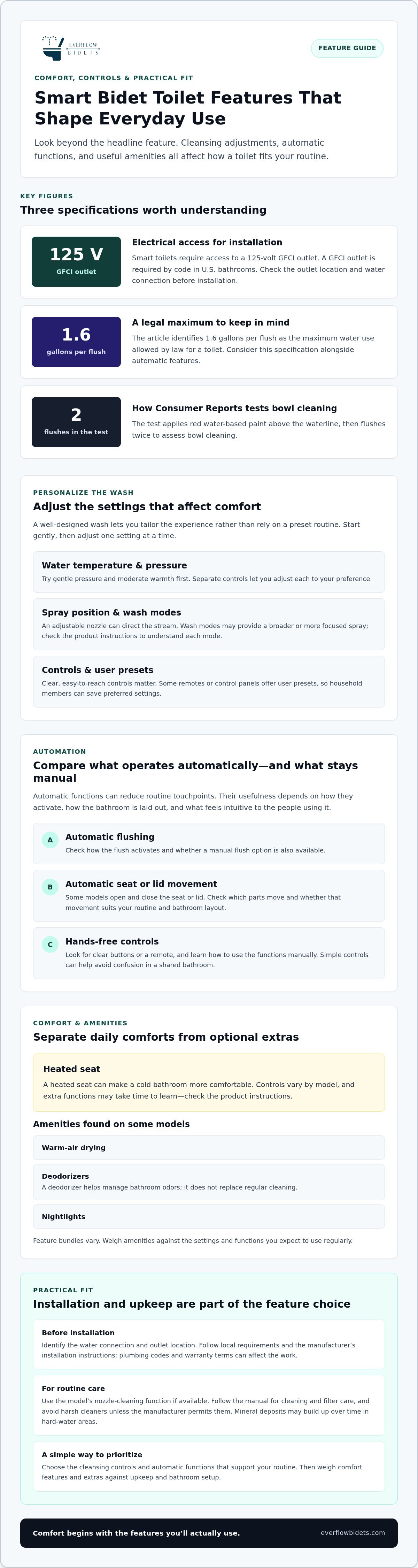
Installation involves more than connecting water. Smart toilets require access to a 125-volt GFCI outlet, and a GFCI outlet is required by code in U.S. bathrooms. Before installation, identify the toilet’s water connection and the outlet location. Plumbing codes and warranty terms can affect the work: follow applicable local requirements and the manufacturer’s installation instructions. Warranty coverage depends on the specific product terms.
Maintenance starts with the nozzle. Use the model’s cleaning function, if available, and follow the manual for cleaning the nozzle and surrounding surfaces. Avoid harsh cleaners unless the manufacturer permits them, as unsuitable products can damage finishes or components. Mineral deposits may build up over time in areas with hard water, so follow the manual’s routine-cleaning instructions to keep parts in good working order.
Some models have water treatment or filtration components, while others use the home’s water supply directly. Care requirements vary, so follow the product instructions for filter replacement or cleaning. A deodorizer is a separate feature that helps manage bathroom odors, but it does not replace regular cleaning. Weigh these extras against the controls you’ll use every day, especially if easy upkeep is a priority.
Automatic flushing, lids, and hands-free controls
Automatic functions can reduce routine touchpoints, but their usefulness depends on how they work in your bathroom. Compare the flush trigger, lid movement, and manual controls before choosing.
Hands-Free Flushing
Automatic flushing operates without the usual hand-controlled flush, adding convenience after use. Check how it activates and whether the toilet also has a manual flush option. In a shared bathroom, clear controls help household members understand when to rely on automation and when to use the standard control.
Automatic Seat and Lid Movement
Some smart toilets automatically open and close the seat or lid, so you don’t have to lift or lower them by hand. Check whether the model moves both or only the lid, and consider which suits your routine. In a household with different preferences, intuitive controls can make automatic movement less disruptive.
Think through a typical visit before deciding whether hands-free operation would make you more comfortable. Automatic flushing, for example, may suit you if you want fewer manual steps, while a conventional control may feel more familiar to guests. The key is choosing automation that supports your routine rather than adding functions you’d rather manage yourself.
Automatic lid movement changes how people approach the toilet. A lid that opens without lifting can simplify access, and automatic closing can remove a small household task. Consider the bathroom layout and nearby fixtures, then check how the seat and lid move. Make sure their movement suits the space and the people using it.
Consider the controls as well as the automatic functions. Look for clearly labeled buttons or a remote, and learn how to operate flushing and lid movement manually. In a shared bathroom, simple controls can reduce confusion. Ask whether everyone can understand the basic functions without a lengthy explanation.
Automatic operation isn’t the only option. Some users may prefer to control flushing or lid movement themselves, while others value the reduced handling. Decide which functions matter in your daily routine, then compare models based on those priorities rather than choosing the longest feature list. For a broader comparison, explore smart toilet options and configurations.
Smart toilets may include heated seats, warm-air dryers, deodorizers, night-lights, automatic flushing, and automatic seat or lid movement. Feature bundles vary, so compare what fits your routine instead of treating every addition as essential.
Consumer Reports tests smart toilets' bowl cleaning by flushing twice after applying red water-based paint above the waterline. The maximum water use allowed by law for a toilet is 1.6 gallons per flush, another specification to consider alongside automatic features.
Heated seats
Smart bidet toilets combine cleansing and convenience features in one fixture, but they also have electrical components and upkeep requirements. A heated seat can make a cold bathroom more comfortable, while the controls and extra functions may take time to learn. The right option depends on whether the benefits suit your routine and bathroom setup.
Check how the heated seat is controlled before choosing a model. Some let users select a preferred setting, while others have simpler operation; consult the product instructions for the specific controls. If the bathroom is shared, consider whether everyone can easily adjust the seat or use its settings. Comfort is personal, so straightforward controls can matter as much as heat.
A bidet seat upgrades a compatible existing toilet, while a smart toilet combines the toilet and electronic functions in one fixture. A seat keeps your existing bowl; a smart toilet replaces the fixture. Compare your bathroom plans, the seat’s fit requirements, and the features you expect to use. A complete replacement may suit a remodel, while a seat may be a better fit if you’re keeping your current toilet.
Electric bidet seats typically offer more features than nonelectric seats, but they need access to an electrical outlet. Before choosing one, review the installation instructions and confirm that your toilet’s shape and mounting arrangement meet the requirements. For a full smart toilet, consider how its dimensions and connections fit the bathroom layout. These checks help clarify installation needs before purchase.
Some smart toilets and bidet seats include warm-air drying, which can reduce reliance on toilet paper after washing. It’s separate from a heated seat: one warms the sitting surface, while the other directs warm air after cleansing. If you want both, compare their controls and operating steps rather than assuming one feature includes the other.
Consider your usual routine: would a warm seat matter most on cold mornings, or would hands-free drying be more useful after cleansing? A household member who prefers a familiar routine may value straightforward controls over extra settings. List the functions you want, then compare each model’s installation instructions and maintenance guidance.
To keep the seat in good condition, follow the manufacturer’s cleaning directions and use products approved for its surfaces. Don’t apply cleaners directly to electronic controls unless the instructions permit it. A smart toilet has more integrated components than a basic fixture, so review its care requirements before deciding. Aim for a balance of comfort and convenience without functions you won’t use.
Integrated bidet washing and adjustable wash settings
Integrated wash settings let you adjust water pressure and temperature through the toilet’s controls. Start with a gentle spray and comfortable warmth, then adjust each setting separately. This helps you learn how the controls affect your cleansing experience without changing several things at once. If the toilet saves preferences, use that feature to return to a familiar setup.
Look for controls that make each adjustment clear. A remote or side control may let you adjust spray position, pressure, and temperature independently. One household member, for example, might prefer lower pressure, while another chooses a different setting. Read the operating instructions to understand the available wash modes and how to stop or change a cycle.
An integrated system builds bidet washing functions into the toilet rather than adding a separate attachment. This creates a coordinated fixture, but means you choose the toilet and washing functions together. Compare the controls, wash options, and cleaning instructions as part of the same purchase decision. An easy-to-use setting matters more than a long menu of unfamiliar options.
Nightlights add visibility in a dark bathroom without requiring the main light. Before choosing, consider where the light appears and whether it helps you see the bowl and nearby controls. Integrated lighting may be built into the toilet, but its position and operation vary by model. Review product instructions or images to understand what the light illuminates.
Tank design is another consideration. Some smart toilets have an integrated tank, while tankless models use a different configuration. Tank style affects the toilet’s overall shape and how it fits your bathroom layout. Compare dimensions and installation requirements rather than assuming all integrated toilets use the same arrangement.
Compare wash controls by identifying pressure and temperature adjustments, spray position, and any preset options. Then consider which you’d actually use. A household sharing one toilet may value individual settings, while someone seeking simple operation may prefer fewer controls. Choose a model that supports comfortable, repeatable cleansing.
Include cleaning in your decision. Check how the nozzle is cleaned and whether the instructions describe a dedicated cleaning function. Follow the manufacturer’s guidance for the toilet’s surfaces and controls. Clear wash adjustments and accessible cleaning instructions help you understand daily use and routine care before choosing an integrated model.
Smart toilet features and amenities
Advanced amenities are most useful when they solve an everyday problem. When comparing smart bidet toilet features, consider how each function fits your bathroom habits, not just how many appear on a product list. A night-light can improve visibility during nighttime visits, while a deodorizer helps manage odors. Decide which outcome matters most in your household.
Some smart toilets combine washing functions with a warm-air dryer, automatic flushing, or automatic lid movement. Others may have a foam barrier on the bowl water to reduce splashing and trap odors. Treat each as a distinct amenity: a dryer changes your post-wash routine, while a foam barrier changes the bowl experience. Check the product description to see which functions a model includes.
- Nightlight: Consider where its light falls and whether that placement suits your bathroom.
- Deodorizer: Check how the feature operates and what care the manufacturer recommends.
- Warm-air dryer: Decide whether you prefer this step after cleansing.
- Foam barrier: Consider whether splash reduction and odor trapping are useful priorities.
Compare operation and upkeep together. A remote-controlled function, for instance, may be convenient for one person but unnecessary for someone who prefers direct, simple controls. Review each amenity’s operating and care instructions before deciding whether its benefit outweighs the added complexity.
Household preferences can differ. One person may value a night-light, while another prioritizes a deodorizer or automatic flushing. List shared priorities, then separate essential functions from optional extras. This is especially useful in a guest bathroom, where straightforward controls may matter more than specialized amenities.
Electrical access matters for powered functions. Electric bidet seats typically offer more features than nonelectric seats, but need access to an electrical outlet. Compare the selected model’s installation instructions with your bathroom setup, and consider cleaning and maintenance alongside everyday convenience. A feature is a better fit when both its use and upkeep feel manageable.
Choose amenities by matching them to specific needs, such as low-light visibility or a preference for hands-free operation. Then compare the product’s instructions to understand controls and care. To explore smart toilet configurations, view smart toilet options and focus on the functions that support your routine.
EverFlow Bidets: Bidet Toilets
EverFlow Bidets sells bidet toilets, bidet toilet seats, and bidet toilet combinations to help you match features with your bathroom plans. Choose a complete bidet toilet for washing functions integrated into one fixture, or consider a bidet seat to upgrade a compatible existing toilet. A bidet toilet combination is another integrated option when planning a bathroom update.
Before deciding, list the features you expect to use, such as adjustable washing, a heated seat, or automatic functions. Then compare those priorities with the product type and your bathroom layout. This helps you focus on everyday comfort instead of extras that don’t suit your routine.
For help exploring options, contact EverFlow Bidets or visit everflowbidets.com.
Choose Comfort That Fits Your Routine
The best choice is the one that feels natural in your home, not the one with the longest feature list. Picture how the toilet will be used day to day, who will use it, and which controls need to feel straightforward. This practical approach keeps comfort, ease of use, and bathroom plans at the center of your decision.
Choosing among smart bidet toilet features is also a chance to consider what you’ll value over time. A thoughtful upgrade can support a more comfortable, independent daily routine when the controls and care needs suit the people using it. Compare options without assuming every advanced function is essential.
If you’d like help narrowing your options around your priorities, share your questions with EverFlow Bidets. A considered choice can make everyday bathroom routines feel more comfortable and personal.
Frequently Asked Questions
What features do smart bidet toilets typically include?
Feature sets vary, but commonly combine cleansing with comfort and convenience functions. Some models also let users save personal settings. For example, TOTO S5, S7A, G5A, G5A Lite, and NEOREST LS remotes include memory for up to four users. In a shared bathroom, saved preferences can reduce repeated adjustments. Compare how each control works and whether household members can use it comfortably.
What are the differences between smart bidet toilets and bidet toilet seats?
A smart bidet toilet integrates its functions into a complete toilet, while a bidet seat is designed to fit an existing toilet. The practical choice partly depends on whether you’re keeping your current fixture or replacing it. Before selecting a seat, compare its shape and mounting requirements with your toilet. For a full replacement, account for the new fixture’s dimensions and your bathroom layout.
What installation requirements and electrical connections do smart bidet toilets need?
Electrical specifications and bathroom fit requirements vary by model. For example, TOTO NEOREST LS requires a 120 V GFCI outlet within 4 feet of the toilet. Rough-in dimensions matter too: a 12-inch rough-in is standard, while a 10-inch option is available for a specific TOTO Drake model. Compare the exact model requirements with your bathroom measurements before planning installation.
How much water and electricity do smart bidet toilets use?
Water use varies by flush setting and model. Water use varies by model and flush setting, so compare the selected model’s published specifications. Electricity use varies with powered functions, such as seat heating and water warming, as well as how often they operate. Compare the selected model’s published energy-use information with the features you expect to use regularly.
What safety and hygiene features should smart bidet toilets have?
Consider accessible seating dimensions and features designed to support routine hygiene. Check each model’s seating height and accessibility features against the needs of its users. For hygiene, TOTO models include TORNADO FLUSH® with CEFIONTECT® glaze; S5, S7A, and NEOREST LS also include EWATER+® wand auto-clean. Compare these model-specific features with the users’ needs and the product’s care instructions.
How much do smart bidet toilets cost in the United States?
Disclaimer
The information provided in the EverFlowBidets blog is for general informational and educational purposes only. While we strive to publish accurate, current, and well-researched content, nothing on this website should be considered medical advice, diagnosis, or treatment. Articles discussing the potential health, hygiene, accessibility, or environmental benefits of bidet use are based on publicly available research, manufacturer information, and other reputable sources. Individual results may vary, and any health-related decisions should be made in consultation with a qualified healthcare professional.