

What makes a bidet worth the investment: lower paper use, a more comfortable routine, or easier personal care? If you’re asking, “are bidets worth it,” the answer depends on your household’s priorities, bathroom setup, and the product you choose.
Before changing a familiar routine, consider the purchase, setup, and upkeep. A bidet may reduce toilet paper use, but the amount varies from household to household, so savings aren’t guaranteed or immediate.
This guide will help you weigh comfort and hygiene alongside water and paper use, maintenance, and bathroom compatibility. You’ll also learn how bidet toilet seats, bidet-toilet combinations, and bidet toilets differ. Whether your priority is comfort, easier personal care, or using less paper over time, you’ll have a practical way to decide whether the benefits justify the setup and ongoing care.
Key Takeaways
- Decide whether bidets are worth it by weighing their everyday benefits against purchase, setup, and maintenance.
- Consider whether water cleansing fits your personal care routine, without assuming the same comfort or hygiene experience for everyone.
- Estimate paper-use changes realistically, since household habits affect how much toilet paper you use.
- Match the setup to your bathroom plans: a bidet seat, bidet-toilet combination, or bidet toilet suits different priorities.
- Before choosing, identify your main goal, assess your bathroom, compare formats, and review product requirements.
Are Bidets Worth It? Start With What You Want to Improve
A bidet can be worthwhile, but its value depends on your routine and priorities. If you’re asking, “are bidets worth it,” start with the benefit you’d notice in everyday use, rather than assuming every household needs a more elaborate bathroom fixture.
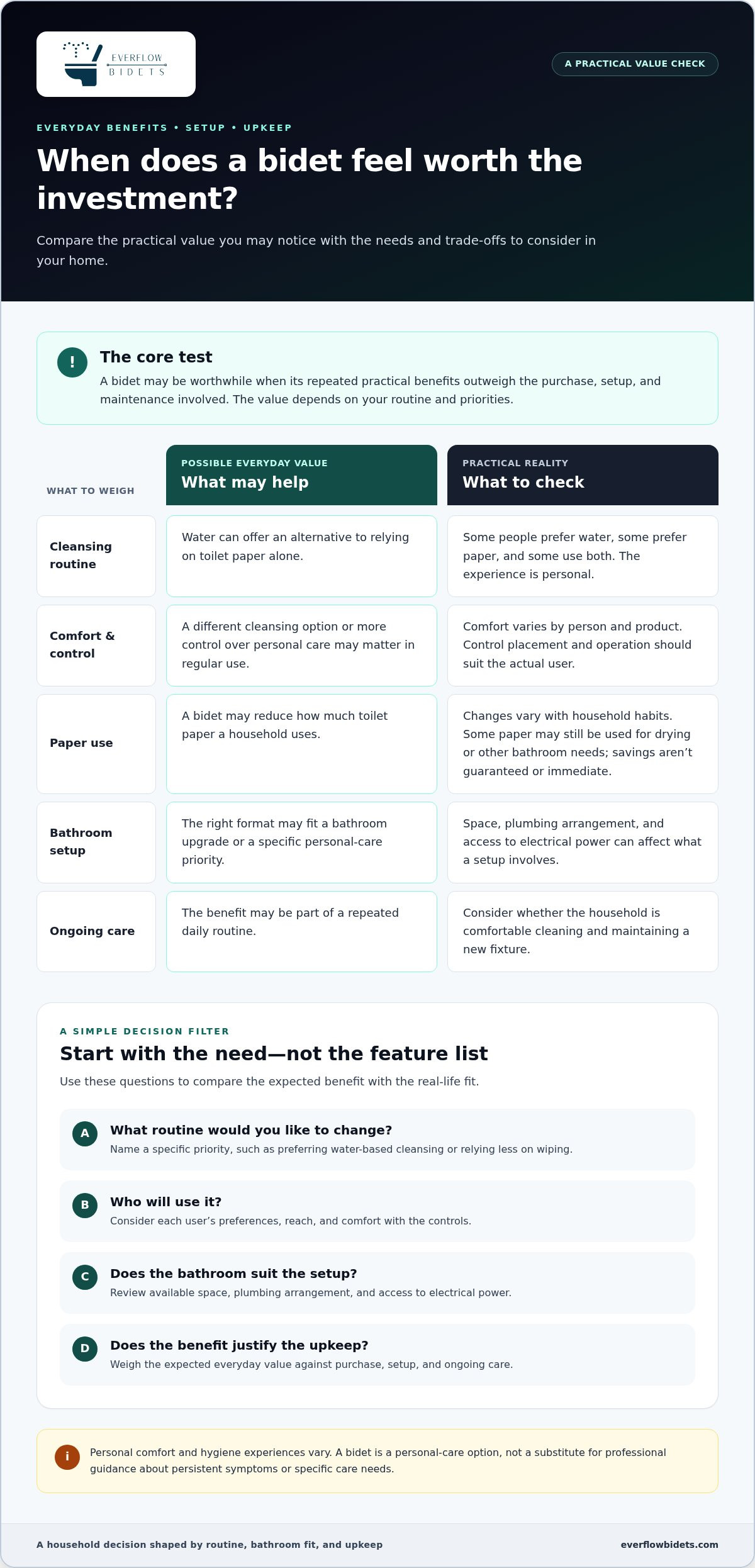
A bidet is worth the investment when its repeated practical benefits outweigh the purchase, setup, and maintenance involved. That benefit might be a preferred way to cleanse, a more comfortable routine, or greater control over personal care. It doesn’t need to be a luxury feature to matter, and it won’t have the same value for everyone.
Try this quick value test: name the specific task or frustration you want an upgrade to address. Be precise. “I want a better bathroom” is broad, while “I’d prefer water-based cleansing” gives you a useful standard for comparing options.
- Identify the routine you want to change, such as relying less on wiping or adding water cleansing.
- Consider who will use the fixture and whether each person shares that priority.
- Think about whether the benefit would matter in regular use, not just during a remodel.
- Weigh that expected value against the space, setup, and care the fixture may require.
Which everyday needs can make a bidet feel worthwhile?
Some people prefer water as part of their cleansing routine instead of relying on toilet paper alone. Others appreciate having another option alongside wiping, though individual habits vary. Comfort, convenience, and a greater sense of personal control can also influence the decision. These are personal preferences, not guaranteed outcomes. For background on the history and types of bidets, see this overview.
When might a bidet not feel worth the change?
If everyone in the household is content with the current routine, a bidet may not offer enough day-to-day value to justify changing it. Bathroom space, setup requirements, and willingness to clean a new fixture are also practical considerations. These are reasons to assess fit, not automatic deal-breakers based on a person’s age, health, or household type.
Use your named priority as a filter. If you can identify a recurring need and see how a bidet could address it, the upgrade may deserve a closer look. If the benefit is still vague while setup and upkeep feel like extra work, compare formats before deciding.
Bidet Benefits in Daily Use: Hygiene, Comfort, and Independence
Are bidets worth it for everyday personal care? For some users, water offers a welcome alternative to relying on toilet paper alone for cleansing. Others prefer paper or use both. The practical difference is clear, but the experience depends on personal preference and how each person uses the fixture.
What can water-based cleansing change about a bathroom routine?
In general, the user operates the bidet’s controls to direct water for cleansing, then dries as desired. The steps depend on the product and its controls. Some people use less paper, while others use it to pat dry or for other bathroom needs. A bidet doesn’t necessarily remove paper from the routine. For practical steps, see this guide to using a bidet.
Water offers an alternative to repeated wiping, which may appeal to someone who prefers that sensation or wants another way to manage personal hygiene. That preference isn’t a medical claim: a bidet shouldn’t be presented as preventing, treating, or curing a health condition. If you have persistent symptoms or specific care needs, speak with a healthcare professional for appropriate guidance. Personal preference and medical treatment are different considerations.
How can a bidet support comfort and personal independence?
Convenience can matter in small, repeated moments. Someone who finds reaching or wiping difficult may value a cleansing option that better suits their abilities. The experience depends on the individual and the product, and a bidet won’t remove every challenge. Ease of use may depend on control placement, how the controls operate, and whether the user can comfortably reach and understand them.
Consider who will use the bathroom and what each person finds manageable. Hands-on controls may be straightforward for one person, while another may prefer a different layout. The shape and arrangement of the fixture can also affect how it fits the user’s routine and the surrounding bathroom. Review product details with the actual user in mind instead of assuming one configuration suits everyone.
Comfort and hygiene experiences vary by user and product, depending on individual preferences, mobility, control layout, and how a bidet fits into an existing routine. The user’s priorities matter more than broad promises. A feature that supports one person’s independence may make little difference to someone else.
For a household considering this everyday change, exploring bidet options can help connect personal priorities with different product formats. Start with what the user wants to make easier, then consider whether the controls and overall setup seem practical for daily use.
Bidet Costs, Paper Use, and Upkeep: Assess the Real Trade-Off
A realistic cost assessment looks beyond the product itself. Consider what the fixture requires to fit your bathroom, the care it needs, and whether your household’s paper habits might change. These factors help answer “are bidets worth it” without assuming a purchase will pay for itself or produce the same result in every home.
How should you think about purchase and setup costs?
Separate the product purchase from any project-specific setup. A bidet seat may involve different bathroom considerations than replacing a toilet with a bidet toilet or combination. Existing space, plumbing arrangement, and access to electrical power can affect what a particular setup involves. Review the product requirements alongside your bathroom conditions to understand what the full project entails.
Use the comparison below as a checklist, not a price estimate. Your setup and routine will determine which factors matter most.
| Factor | What to consider |
|---|---|
| Upfront purchase | Compare the product format and features you value with your household’s priorities. Avoid paying for options you don’t expect to use. |
| Setup | Account separately for any project-specific installation or electrical work. Requirements can vary with the product format and bathroom conditions. |
| Ongoing care | Plan for routine cleaning and follow the product maker’s care instructions. Consider whether your household is comfortable maintaining another bathroom fixture. |
| Paper use | Think about whether users might use less paper, continue using it to dry, or keep their habits much the same. |
What ongoing effort belongs in the value calculation?
Every added fixture requires some routine care. Consider whether household members will learn the controls, keep the unit clean, and follow its care instructions. These tasks may feel simple to one household and like extra work to another. Include that effort in your decision alongside the daily convenience or comfort you hope to gain.
Paper use is just as personal. Someone who prefers to air-dry may use less toilet paper than someone who uses paper to pat dry. Other household members may continue using paper as before. A bidet may change how much paper a household uses, but the size of that change depends on actual habits, not the product alone.
No universal savings estimate applies to every household. For a practical comparison, note your current paper routine, consider which users might change it, and weigh any expected difference against purchase, setup, and care. Don’t count on a guaranteed reduction or payback period. Your estimate is most useful when it reflects your home’s likely routine, not an idealized one.
Which Bidet Setup Fits Your Home and Your Priorities?
The right format depends on how much of the bathroom you want to change. If you want to keep your existing toilet, a bidet toilet seat may be a logical place to start. If replacing the toilet is already part of your plans, a bidet toilet or bidet-toilet combination may better fit the project. Whether bidets are worth it can also depend on which format suits your bathroom and routine.
| Format | A useful fit to consider | Main planning question |
|---|---|---|
| Bidet toilet seat | You want to add a bidet function while keeping the existing toilet, if compatible. | Does the seat fit your toilet and suit the bathroom setup? |
| Bidet toilet | You’re considering a full toilet replacement as part of a bathroom project. | Does replacing the fixture fit the project’s scope and your preferences? |
| Bidet-toilet combination | You want to consider a combined fixture as part of a broader upgrade. | Do the bathroom conditions and project plans accommodate a complete fixture change? |
When is a bidet seat the more practical option?
If keeping your current toilet is a priority, a bidet seat is a category worth comparing. It can be a focused upgrade, but fit isn’t universal. Toilets differ, and available space or other bathroom conditions can affect compatibility. Compare the product details with your toilet and bathroom before deciding.
Explore the bidet toilet seat collection with your existing fixture in mind. Check compatibility alongside your preferences: an option only makes sense if it fits your toilet and bathroom.
When should you consider a bidet toilet or combination?
A bidet toilet or combination may be worth exploring when replacing the toilet is already part of your plans, or when you prefer a complete fixture upgrade. Project scope, bathroom conditions, and the way you want the finished space to function all matter. For more context as you compare, see this guide to modern bidets and wellness.
If a combined fixture aligns with your plans, browse the bidet-toilet combination collection. You can also compare bidet toilets as part of a full replacement. Neither format is automatically better; the right one depends on the project and your priorities.
To narrow your options, decide whether you’re keeping the current toilet, replacing it, or still planning the bathroom project. Then compare product details with your space and routine. Explore bidet options for your home to consider which format fits your plans.
Making the Decision: A Simple Next Step if a Bidet Seems Worth It
A clear decision doesn’t require predicting exactly how much a bidet will change your routine. It requires matching the benefit you want with a setup that works in your bathroom. Use this sequence to move from “I’m considering one” to a product category you can evaluate with confidence.
- Name your priority. Write down why you’re considering a bidet, such as preferring water-based cleansing, making personal care more convenient, or planning a bathroom upgrade. A specific goal helps you judge whether a product’s details are relevant or simply appealing extras.
- Assess your bathroom. Decide whether you want to keep the existing toilet or include a toilet replacement in a broader project. Consider available space and the existing bathroom setup, since these can shape which formats are practical.
- Choose a format to compare. If retaining your toilet matters, explore bidet seats. If you’re planning a larger fixture upgrade, compare bidet-toilet combinations and bidet toilets. Treat this as a starting point, not a rule that one category is right for every home.
- Review the product details. Compare the stated features and requirements with your priority, toilet, bathroom conditions, and household routine. Focus on what you expect to use and what the setup needs, rather than choosing by appearance or feature count alone.
Use your priorities to narrow the product category
Keeping the existing toilet points toward bidet seats, with compatibility as an essential part of the comparison. If your plans involve a broader fixture upgrade, a bidet toilet or bidet-toilet combination may be worth considering. Read product information in the context of your space and routine. The right choice addresses your priority and fits the project, rather than being selected simply because it is popular.
Explore bidet options with EverFlow Bidets
EverFlow Bidets offers bidet toilet seats, bidet-toilet combinations, and bidet toilets for households comparing different approaches. If replacing the toilet is part of your plan, review the bidet toilet collection and compare product details with your bathroom and priorities.
Start with the category that best matches your project, then use your priority as a filter while browsing. Explore bidet options from EverFlow Bidets to compare formats and find one that makes sense for your household.
Choose the Bidet Upgrade That Fits Your Next Step
The best decision connects to a real part of your daily life. If you’re still unsure whether bidets are worth it, picture how you’d use one in your own bathroom, then decide whether that change matters enough to explore. You don’t need the most elaborate setup. A considered choice starts with your routine and the room you have.
EverFlow offers bidet toilet seats, bidet-toilet combinations, and bidet toilets from brands including TOTO, Horow, Bio Bidet, and Cascade. Use those categories as a starting point, then compare product details with your bathroom, preferences, and plans. The right fit is personal, and taking time to choose is part of making the upgrade worthwhile.
Explore bidet options for your home and compare the formats that align with your priorities. Start by finding an option that feels practical for your household, then review its details.
Frequently Asked Questions
Do bidets replace toilet paper completely?
No, a bidet doesn’t have to replace toilet paper completely. Some users keep paper on hand to dry, while others use a different drying approach or continue their usual routine. If you share a bathroom, expect household members to settle into different habits rather than assume everyone will use it the same way. The practical question is whether adding water cleansing suits your routine, even if paper remains part of it.
Do bidets use a lot of water?
Typically, a bidet wash uses a small amount of water, though consumption depends on the product and how it’s used. To assess resource use, consider the water used for each wash alongside your household’s existing paper habits. A bidet adds water use at the toilet, but that alone doesn’t determine its overall environmental impact. If conservation is a priority, review the product information and consider your own usage patterns.
Can you install a bidet in a bathroom without an electrical outlet near the toilet?
Possibly, because electrical requirements vary by bidet type and product. Some bidet options operate without electricity, while electric models require an appropriate power source. If there’s no outlet near the toilet, don’t assume every option is ruled out, but don’t assume a specific product will work either. Check the product’s stated requirements and consider the bathroom layout before choosing a format or planning changes to the space.
Are bidets difficult for guests or first-time users?
Most first-time users need a moment to understand the controls and decide what feels comfortable. A brief explanation can help guests understand what the fixture does and that using it is optional. Keep the usual toilet paper available, and avoid assuming visitors will want to try it. If several people share the bathroom, clear product information and a simple introduction can make the setup easier to understand without pressure.
Can a bidet help with hemorrhoids or other medical concerns?
A bidet shouldn’t be treated as a proven way to prevent, cure, or treat hemorrhoids or another medical condition. People may have different comfort experiences, but that isn’t a substitute for medical advice. If you have persistent symptoms, pain, or a specific care need, speak with a healthcare professional before relying on a bidet as part of your care routine. They can help you decide what’s appropriate for your situation.
Is a bidet a good choice for someone with limited mobility?
It may be a useful option for someone who wants a different way to manage personal hygiene, but suitability depends on the person and setup. Consider whether the user can sit and transfer comfortably, reach and operate the controls, and use the bathroom safely. If possible, include the intended user in the decision. For mobility-related or care concerns, a healthcare professional can offer guidance tailored to the individual.
Disclaimer
The information provided in the EverFlowBidets blog is for general informational and educational purposes only. While we strive to publish accurate, current, and well-researched content, nothing on this website should be considered medical advice, diagnosis, or treatment. Articles discussing the potential health, hygiene, accessibility, or environmental benefits of bidet use are based on publicly available research, manufacturer information, and other reputable sources. Individual results may vary, and any health-related decisions should be made in consultation with a qualified healthcare professional.